Estepona is the westbound day from Urb. El Paraíso. San Pedro de Alcántara, Puerto Banús and Marbella Old Town all sit the other way, back toward Málaga. This one is a walked old centre, a long town beach, and a marina where you can eat without the show.
How long is the drive from El Paraíso?
From the apartment to Plaza de las Flores, a routing check in clear traffic comes out at about 22 minutes and about 17 kilometres. When the A-7 queues, allow 30 minutes or more. The clear-road time is not a promise for a summer weekend.
Leave the urbanization on the local roads and join the A-7 (Autovía del Mediterráneo) heading west. You do not pass San Pedro on this drive. San Pedro is east of El Paraíso. Westbound, the motorway runs past Cancelada, on the eastern side of Estepona, and then toward the centre. The same route leaves the A-7 onto Avenida Juan Carlos I, the avenue into town. Follow signs for the centre and park. Plaza de las Flores is pedestrian, so walk the last part.
A car is the practical way to do this from the apartment. If you are picking one up for the trip, the airport leg is in the Málaga Airport to El Paraíso guide, and the hire itself is in car rental in Benahavís.
Where to park
Estepona runs a municipal network of underground car parks. A town hall notice of 29 December 2025 lists five in service: Plaza Antonia Guerrero, the athletics stadium, Plaza del Ajedrez, the new town hall building, and La Viña. For this outing, use the three by the centre. The stadium and Plaza del Ajedrez are the wrong side of the trip.
- Plaza Antonia Guerrero is under a square on the old town walking route, so you step out into the lanes.
- The town hall car park is under the council building on Avenida Juan Carlos I, the avenue you use coming off the A-7. The council publishes that building at number 40.
- La Viña is the other central one. The same notice says it moved from a private concession into the municipal network.
The published municipal price in that notice is 1 euro from 9:00 to 21:00 and 2 euros from 21:00 to 9:00. For La Viña it lists 3 euros if the car stays 24 hours. Read the board at the barrier in case the tariff has moved. Two further car parks were still worksites in later town hall updates: one by Iglesia del Carmen (final phase on 30 April 2026) and one under the new boulevard (cover works still going on 9 September 2026). Do not plan on either until you see it open.
Things to do in Estepona
For a first visit, keep it simple: the flower lanes around Plaza de las Flores, the mural route, a beach (La Rada or El Cristo) and the marina. If you have an extra hour, or the weather turns, add the Orchid House. The sections below take them in that order.
The Orchid House (Orquidario)
The Parque Botánico Orquidario is on Calle Terraza, a short walk north of Plaza de las Flores. Under three glass domes (the tallest is 30 metres) it keeps more than 1,500 orchid species, plus a 15 metre indoor waterfall, and the town's tourism office calls it the largest collection of live orchids on show to the public in Europe. Published hours are Tuesday to Saturday 10:00 to 13:30 and 15:00 to 18:00, Sundays and holidays 10:00 to 14:00, closed on Mondays. Adult entry is 5 euros, paid at the door. Check the hours before you go, as they can change.
Plaza de las Flores
Start here. A provincial heritage note calls it a large pedestrian square and the centre of town life: 19th century houses, a fountain in the middle, and the garden of flowers that gave it the current name. Earlier names include Plaza de la Constitución. Casa de las Tejerinas, on the square, holds the municipal tourist office. The office address is Plaza de las Flores.
The flower streets
There is no single street called Calle de las Flores on the town's own route. What people mean is the old centre itself. The tourism page for the Ruta de Rincones con Encanto calls it an urban garden, El Jardín de la Costa del Sol: white houses, quiet squares, and streets decorated with pots full of flowers. The walk it publishes starts at the tourist office on Plaza de las Flores.
A few stops show the idea without a long march. Calle Damas is near the start. Pasaje María Cintrano is entered under an arch of flowers, with bougainvillea beyond it. Plaza Juan Bazán keeps the look of an Andalusian patio, with pots on the walls and bougainvillea that the tourism page says flowers for most of the year. An hour in these lanes is enough before the beach. In July 2021 the town hall said the project had already remodelled more than 130 streets of the historic centre. That is the scale of it, not a list you need to finish.
The mural route
The same streets carry the Ruta de los Murales. The tourism office describes Estepona as an open air museum: paintings on building fronts across different neighbourhoods, plus sculptures and poems. You do not buy a ticket. You walk.
The town hall leaflet dated May 2025 numbers 74 murals. They are not all in the old centre. Schools, sports halls and outer neighbourhoods, including Cancelada, are on the same sheet. From Plaza de las Flores you only need the ones nearby.
Two are worth knowing by name. On the square, the leaflet lists an anonymous 19th century mural, number 42 on that sheet. On Calle Calvario, Estepona se viste de flores by Susana Velasco Martínez shows a sloping cobbled street with hanging pots. The tourism page says it was selected in the second international mural contest in Estepona, in 2019.
The promenade and the beaches
La Rada
Playa de La Rada is the town beach. The tourism page calls it the most emblematic in Estepona, with lifeguard cover, and says it sits a step from the main streets, which is why it pairs with the old town. Listed length is 2,630 metres. The sand is grey and fine. Services on that page include toilets, access for disabled visitors, showers, parking, boardwalks, beach bars and watersports. In summer it also notes assisted bathing for people with reduced mobility. The page lists parking but does not name the car park, so for a combined day leave the car in a municipal car park and walk down.
The Paseo Marítimo Pedro Manrique runs along La Rada to the fishing port, about 3 kilometres on the tourism page, with gardens and a cactus collection. Beach bars serve paella, fried fish and sardine espetos. Some stay open late at weekends, with live music.
El Cristo
Playa del Cristo is the smaller beach. The tourism page lists the cove at 680 metres and says it is sheltered from the wind, with clean, mild water and a patch of trees for shade. A provincial guide places it on the west side of town, beside the marina. It calls the beach a good one for children, and notes high occupancy at weekends, so come earlier if you want space. Listed services include accessible parking, changing rooms, showers, toilets and, in summer, assisted bathing. The Puerto Deportivo and the fishing port are about 500 metres away. If you only have time for one beach, walk to La Rada from the old town and leave El Cristo for a day when you also want the harbour.
Blue Flag, and where it actually is
Do not expect a Blue Flag on either beach. The ADEAC list of beaches awarded for 2026 to 2027 does not include La Rada or El Cristo, or any other Estepona beach. The marina does have one. Puerto Deportivo de Estepona is on the ADEAC ports list for the same period, under the short name P.D. de Estepona. The flag is at the harbour, not on the sand.
The marina and something to eat
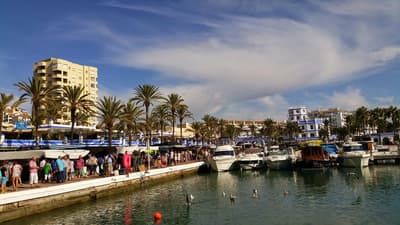
The Puerto Deportivo is run by Marinas del Mediterráneo. Its own page describes Mediterranean cooking, fish and shellfish, and other kitchens, plus ice cream and bars, often with live music. On Sunday mornings a market of about a hundred stalls sets up in the port, selling crafts, clothes and accessories. This guide does not name a restaurant. Rooms on a marina change hands. Walk the quay and read the boards that day. The fishing port, where the promenade from La Rada finishes, is next door, and El Cristo is the beach at this end of town.
Estepona, Puerto Banús or San Pedro
These are different days, and they are not even the same direction from the apartment.
- Puerto Banús is east, and it is the flashier marina: yachts, shops and a night out. Estepona uses the town's own name for the old centre, Jardín de la Costa del Sol: white houses, flower pots, a town beach and a harbour without that show. See the Puerto Banús from El Paraíso guide for that outing.
- San Pedro de Alcántara is also east, and closer. It is the everyday town. Estepona is the other direction and wants a morning, not a quick errand. Use the San Pedro de Alcántara guide for that day.
- Marbella Old Town is east again. Tight lanes and tapas are a separate trip. See the Marbella Old Town guide.
Estepona weather and the best time to go
Estepona has a Mediterranean climate. Summers are hot and dry, with hardly any rain in July and August, and winters are mild, with most of the year's rain falling between autumn and spring. Spring and autumn are the easiest seasons for walking the old town. In summer, do the lanes in the morning and save the beach for later in the day.
A simple plan
- Drive west in the morning and park at Plaza Antonia Guerrero or under the town hall on Avenida Juan Carlos I.
- Start at the tourist office on Plaza de las Flores. Walk a few flower lanes and look up for murals, including the 19th century one on the square.
- Drop down to the promenade and La Rada. If you want the sheltered cove, continue toward the marina and El Cristo.
- Eat at the marina. Do not book a name you have not checked that week.
- Back to El Paraíso for the pool. Leave San Pedro and Puerto Banús for another day.
Booking your stay
El Paraíso is a quiet base in Benahavís, with Estepona a short drive west and the busier resorts back to the east. Check dates and book on the homepage, or find the apartment on Airbnb.
Written by Mex Smits